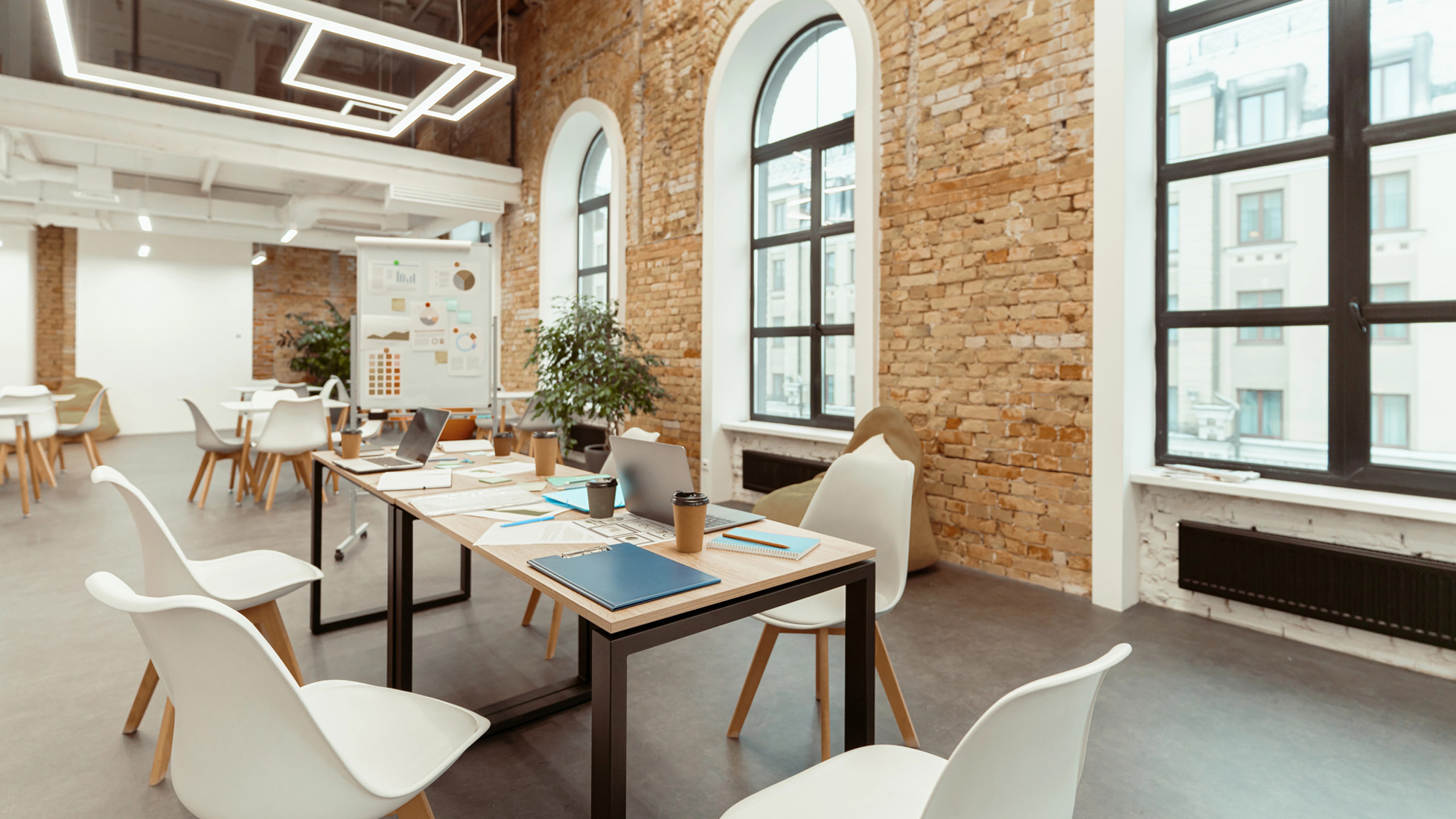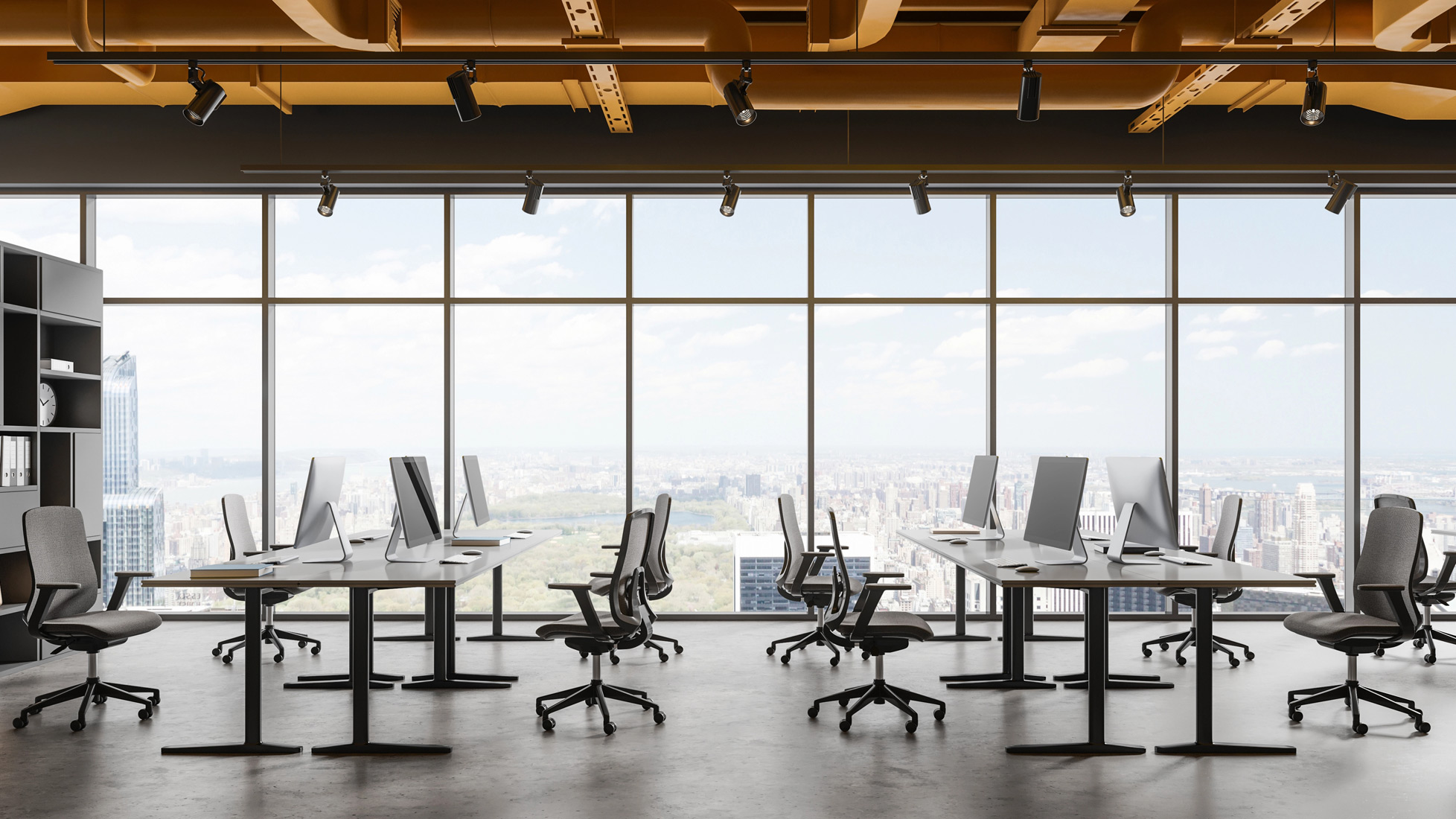


The physical workplace is no longer simply the place where staff show up to do their jobs; today it should be treated as a strategic business tool, which enables a business to fundamentally transform its direction, how it operates and its financial performance.
A well-planned office design is an investment that can drive culture and collaboration and directly influence productivity, employee well-being and retention.
Office Design As A Strategic Business Tool
The way in which a workspace is designed and refurbished can positively impact all aspects of a business. It’s important that time is spent on fully understanding a company’s objectives and workflows and any design is carefully planned and executed. Below are a few of the many ways that office design can make a positive impact on a business:
Space
Office design allows a business to assess or reassess how best to utilise its available workspace.
A study by Abintra Consulting “Wasted Space, The Colossal Cost of under-Used Office Real Estate” set out to discover how much office space was being under-utilised, and to put a cost on that wasted space and found that “ large office-based firms could collectively find an extra 131 million square feet within their existing real estate. The cost to big businesses of this hidden space exceeds £10 billion a year. The report goes onto estimate the cost and square footage lost to underutilisation of office space in London as 36,665,288 sq. ft costing £4,201,841,987 and in the South East: as 20,365,729 sq. ft costing £1,322,550,464.
Knight Frank found that of almost 300 corporate real estate leaders, “More than a third of respondents are either ‘somewhat dissatisfied’ or ‘very dissatisfied’ with the current level of workplace utilisation in their organisations. ‘Delivering higher utilisation & occupancy’ was selected as the greatest workplace management challenge by 30% of our respondents, while another 25% picked ‘aligning workstyles & workplace’.”
When a company moves into a new office space, in order to make the best use of that space, space planning should be undertaken as part of the office design process and should be a top priority once the business’s fit out objectives are understood. This ensures the space is designed specifically for the business looking to occupy the space.
In many cases, especially where a business has occupied a space for some time, the way space is used may become a limiting factor. The space may have gradually become underutilised, or overused, especially if there has been a change in projects, priorities, process or workflow e.g. this can happen when a business moves to a different type of working model e.g. agile or activity-based working which can impact how office areas are used. This is especially true if an office is designed for short terms goals rather than future goals and objectives.
An office design can make sure your current space is fully utilised by looking to future growth while planning to prevent overcrowding. It should look at business processes, take into account employee needs, incorporate the right layout and consider your office requirements in terms of number of employees, and the types of space that will be required including individual office space, meeting rooms, break out areas, kitchen and tea point areas, reception, meet and greet and storage areas.
Productivity
Good office design can positively impact productivity and efficiency. A poorly designed office or an office design that doesn’t include the necessary mitigations e.g. using acoustics to reduce noise distractions can harm productivity. An example of this is shown in a study carried out by Oxford Economics which looked at “When the walls come down: How smart companies are rewriting the rules of the open workplace”. Over 600 executives and 600 employees were surveyed “to better understand what works for employees—and what doesn’t—about open-plan layouts, and to test for disconnects between workers and their managers.” 53% of employees reported that workplace noise decreased their productivity; while only 35% of executives agreed. From the results employees saw a quiet workplace as having more value than executives. The report also stated that it was clear that most businesses didn’t have the office design, technology or strategies in place to deal with the problem of workplace noise.
In a 2019 survey Savills found that 45% of those who responded believed that hot-desking decreased their productivity while only 12% of respondents believed hot-desking increased their productivity. 37% of staff working in open plan areas believed that the office layout had a negative impact on their productivity, which was nearly double the percentage of those working in private offices. Over 60% said they “would most like to spend the majority of their working time from their own dedicated desk as they enjoy the familiarity of their personalised workspace with only 3% favouring a shared desk (hot-desking).”
A review of 10,242 research papers looking at employee outcomes for workers in open-plan offices versus traditional enclosed, individual offices found that open-plan workplace designs “were associated with more negative outcomes on many measures relating to health, satisfaction, productivity, and social relationship.” The research article makes reference to the fact that “notable health outcomes included decreased overall health and increased stress” with “environmental characteristics of particular concern [including] noise and distractions, poor privacy, lighting and glare, and poorer temperature control. Overall, the findings showed that while open-plan workplace designs may offer financial benefits for management, these appear to be offset by the intangible costs associated with the negative effects on workers.”
Mitie’s survey shows that businesses could boost productivity by “investing in well-designed and high performing workspaces.” Mitie reported that “UK employees lose 68 minutes weekly due to unproductive tasks in the workplace and better workplace design leads to higher employee satisfaction and retention” and goes onto say that the financial implications of not taking office design seriously could potentially cost the UK economy £71.4 billion in gross domestic product (GDP) every year.
Office design that is well planned and takes into account the needs of the occupants can boost efficiency and productivity through layout optimisation and by mirroring workflow. Grouping space according to the task can bring staff together to collaborate and improve communication. Utilising sound absorbing materials such as acoustic panels in open plan areas and creating quiet zones can help to reduce noise and distractions allowing staff to focus on the task in hand. Ensuring there is natural light or other lighting can help to reduce eye strain. Equipping staff with ergonomic workplace furniture including height-adjustable sit-stand desks and seating that can be adjusted to suit individual needs provides staff with a comfortable environment that reduces musculoskeletal disorders, repetitive strain injuries and physical and mental fatigue.
Flexibility
Being able to adapt quickly and easily is a valuable business tool. Flexible office spaces enable businesses to be agile and easily change as their needs evolve. Whether it’s changing projects priorities, changing work processes, new team structures, a new working model or an expanding workforce how well an office is designed to be flexible will dictate how quickly a business can reconfigure its workspace to meet changing requirements, allowing it to pivot quickly, adapt to changing project, without the need for redesigns or refurbishment.
The Institute of Designers Ireland says “Decisions about the site, shell, skin and services of office buildings demand careful attention to the long-term changes that are likely to become significant as time goes on. Meanwhile, due attention to the design of services, scenery, systems and settings is the means of ensuring flexible environments for changing businesses.”
A ResearchGate paper “Business Organizations’ Flexibility as an Innovation Tool: Factors Affecting Flexibility in Organizations” recognises that “Organizational flexibility often plays a dominant role as one of the major factors influencing the survival of firms in the market.”
Based on a Harvard Business Review “Rewiring Modern Organisations for Adaptability and Continuous Change” The Fast Company states that “Organizations must adapt to evolving technology; shifting work norms, including remote work and varying schedules; and all manner of uncertainty. More than two-thirds (68%) of leaders say they haven’t found the best way forward to achieve agility and innovation in this age of change.” They go onto say that “While your office layout and environment may not be the first change-management tool that comes to mind, the space in which your employees work has a big impact on everything from their productivity to your company’s ability to scale.”
In order to be flexible an office must be designed so that spaces can be adaptable and multi-functional, rather than being fixed in function. Having adaptability built in means any space within the office can be modified to meet new needs, even temporary ones, and where any changes that have been implemented can be quickly and easily reverted. Having built in flexibility means a business can easily adapt to changing circumstances without major complications or delays, giving them the ability to immediately react to changes as and when required.
Having folding, moveable partitions and screens, and sliding doors alongside modular, flexible, mobile and adaptable furniture can provide a perfect solution to being flexible and being able to make layout changes as required, to meet new business priorities, demands and staff needs.
Sustainability
Many businesses are now looking for office space, to be designed to be sustainable. Sustainable office space reduces energy consumption and bills through energy efficiency; complies with environmental regulations, boosts brand reputation and awareness and has also been shown to increase staff productivity and health and wellbeing, all of which have been shown to increase company growth and profitability.
In the UK Government’s Energy Efficiency for Businesses campaign “Make Saving Energy Your Business” it states that “Nearly half of business electricity usage occurs outside of standard operating hours. Reducing out-of-hours energy use could save your business significant amounts of money. A longer-term investment is lighting timers, which reduce non-essential lighting when employees are not in the area.”
Bain & Company and EcoVadis’s whitepaper on “Do ESG Efforts Create Value?” found “powerful correlations between advanced performance on key sustainability topics and stronger profitability, faster growth rates, or both.” The study states there were four strongly positive correlations between Environmental, Social, and Governance (ESG) and profitability in the areas of sustainable supply chain, renewable energy, employee satisfaction, and diversity, equity and inclusion. In the case of employee satisfaction, results showed that businesses with higher employee satisfaction had a 3-year revenue growth that was 6% higher.
“The triple play: Growth, profit, and sustainability” published by McKinsey and Company states “Revenue growth is good. Profitable growth is better. Profitable growth that advances ESG priorities is best.” McKinsey and Company found that companies who were financially successful and who integrate ESG into their growth plans outperform their peers. McKinsey and Company looked at Total Shareholder Return (TSR), financial performance and ESF ratings of 2,269 companies and found the results suggested a “strong ESG commitment adds additional shareholder value for companies that also exceed their peers in growth and profitability.”
A Science Daily research article “Employees at ‘green’ companies are significantly more productive, study” collected data from a survey of employees at 5,220 French companies, randomly selecting two employees from each company for a pool of more than 10,000 people and found that that “companies that voluntarily adopt international “green” practices and standards have employees who are 16 percent more productive than the average.”
An environmental economist at UCLA’s Institute of the Environment and Sustainability and the UCLA Anderson School of Management, Professor Magali Delmas explains “Adopting green practices isn’t just good for the environment. It’s good for your employees and it’s good for your bottom line. Employees in such green firms are more motivated, receive more training, and benefit from better interpersonal relationships. The employees at green companies are therefore more productive than employees in more conventional firms.”
A survey of over 3,400 office workers, by Foster + Partners and Brookfield Properties, reported that 90% of office employees believe that sustainable workspace design is good for both the planet and their wellbeing. 34% said having a sustainable workspace was more important than an annual bonus.
An office designed with sustainability in mind will utilise natural light in the office layout. When artificial light isn’t available low energy LED lighting systems provide energy efficient lighting. Energy consumption can also be decreased by incorporating sustainable tech and smart technology. By installing a lighting system that senses and switches off outside of normal working hours and where office space is unoccupied, significant energy savings can be made. Smart sensors can help to monitor and control light usage and smart meters can track and control heating, ventilation and air conditioning settings to ensure that the system uses the minimum energy needed to maintain a comfortable environment and contribute to reducing energy bills.
Reusing or utilising recycled, locally sourced, or sustainable materials will reduce a company’s carbon footprint. Sustainability can also be improved by using materials and furnishings that come from renewable resources as well as using natural materials such as stone and Forest Stewardship Council (FSC) certified wood in flooring, doors and office furniture.
Wellbeing
It’s well established that office design can heavily influence the health and wellbeing of staff which in turn can affect staff productivity and a company’s profitability.
A new report from the World Green Building Council found “overwhelming evidence” that office design significantly impacts the health, wellbeing and productivity of staff. The report found that a range of factors that can affect the health, satisfaction and job performance of office workers including indoor air quality, thermal comfort, lighting, views of nature, noise and acoustics and active design and exercise.
The CEO of the World Green Building Council, Jane Henley said “The evidence linking good office design and improved health, wellbeing and productivity of staff is now overwhelming. There is unquestionably a clear business case for investing in, developing and occupying healthier, greener buildings. Most businesses are already sitting on a treasure trove of information that can have an immediate impact on their two biggest expenses – people and buildings. Understanding the relationship between the two can help businesses achieve significant competitive advantage.”
The British Safety Council states that “Environmental factors such as noise, air quality, temperature and ventilation can all impact on the health, wellbeing and productivity of office workers, so it makes sense to address them when designing and running office buildings.”
In a Spectra 360 article 9 key workplace factors were found to significantly affect employee health. One of these factors was environmental conditions including poor air quality, poor lighting, and noise. The article goes further stating “a well-maintained workplace with good ventilation, natural light, and a comfortable temperature can improve mood, focus, and overall well-being” and “setups, like uncomfortable desks, poor lighting, and repetitive movements, can cause musculoskeletal disorders (MSDs) like neck pain, back pain, and carpal tunnel syndrome. The constant discomfort and injuries can make people less productive, cause more mistakes, and lead to more employees leaving their jobs to find healthier work environments.”
Flair HR pulled together “140 Job Satisfaction Statistics: Factors, Benefits, and Trends” and states that 84% of employees report that a comfortable, ergonomically designed workplace directly impacts job satisfaction and 73% of workers state that natural light in a workspace can significantly enhance mood and productivity, increasing job satisfaction.
According to a Workplace Wellness Trend Report by Fellowes one aspect that affects employee productivity is whether their employer has incorporated health and wellbeing into the office environment. They found that 87% of workers wanted their workplace to be a healthy work environment which included company fitness benefits, wellness rooms, ergonomic seating and sit-stand desks. 93% of IT workers said they were more likely to stay at a company who offered healthier workplace options.
Design elements such as finding the right balance of office space types, tackling noise by having the right office acoustics, having breakout areas to allow staff to step away from their desk and take some downtime, providing ergonomic furniture, introducing indoor plants, natural materials, and water features and controlling temperature, humidity and air quality all help to foster a more positive and productive work environment.
Retention and Recruitment
A well-designed office can serve both as a powerful staff retention and recruitment tool. Many employees looking to stay or leave a company base their decisions on the working environment within a business. Staff are far less likely to leave a workplace if they feel their office space is both comfortable and inspiring.
Ekko, who provides solutions to designers, architects, and fit-out contractors, recognises that “the physical workplace has become a strategic tool — one that shapes how employees feel, perform, and ultimately decide whether to join or stay with an organisation. For forward-thinking businesses, office design is no longer a cost centre; it is a talent strategy.” The article goes onto say that the office is a “tangible expression” of a company’s values and as such a well-designed office space signals that a company cares. Conversely an “outdated or poorly maintained spaces can signal the opposite.”
The Office Address agrees and says “In the current competitive landscape for talent innovative offices have emerged as an innovative strategy for retention of employees. There is no longer a time when the steady income alone could stop your top performers from leaving the office. Modern professionals expect more.”
This is backed by research. The Science Direct paper “Saw the office, want the job: The effect of creative workspace design on organizational attractiveness” found that where a company’s creative workspace design enhanced organisational attractiveness that creative workspace design may be perceived as an indicator of a company’s climate for creativity and its innovation ability and is therefore more attractive to employees.
It’s clear that office design is an important and strategic business tool that every company should utilise, as it directly impacts if space is used effectively, how productive staff are, how quickly a business can react to change, how sustainable a company is as well as how it impacts staff heath, wellbeing, retention and recruitment rather than just serving as an aesthetic backdrop.
JBH Refurbishments, Experts In Office Design and Refurbishment
JBH Refurbishments are a cat a and cat b fit out contractor and have over 30+ years experience in Kent and London office design, office refurbishments and fit outs. We understand what’s required to carry out an office design and refurbishment and can provide the right expertise for your Kent or London office refurbishment. You can contact us on 0333 207 0339 or via our contact page for a free on-site consultation.