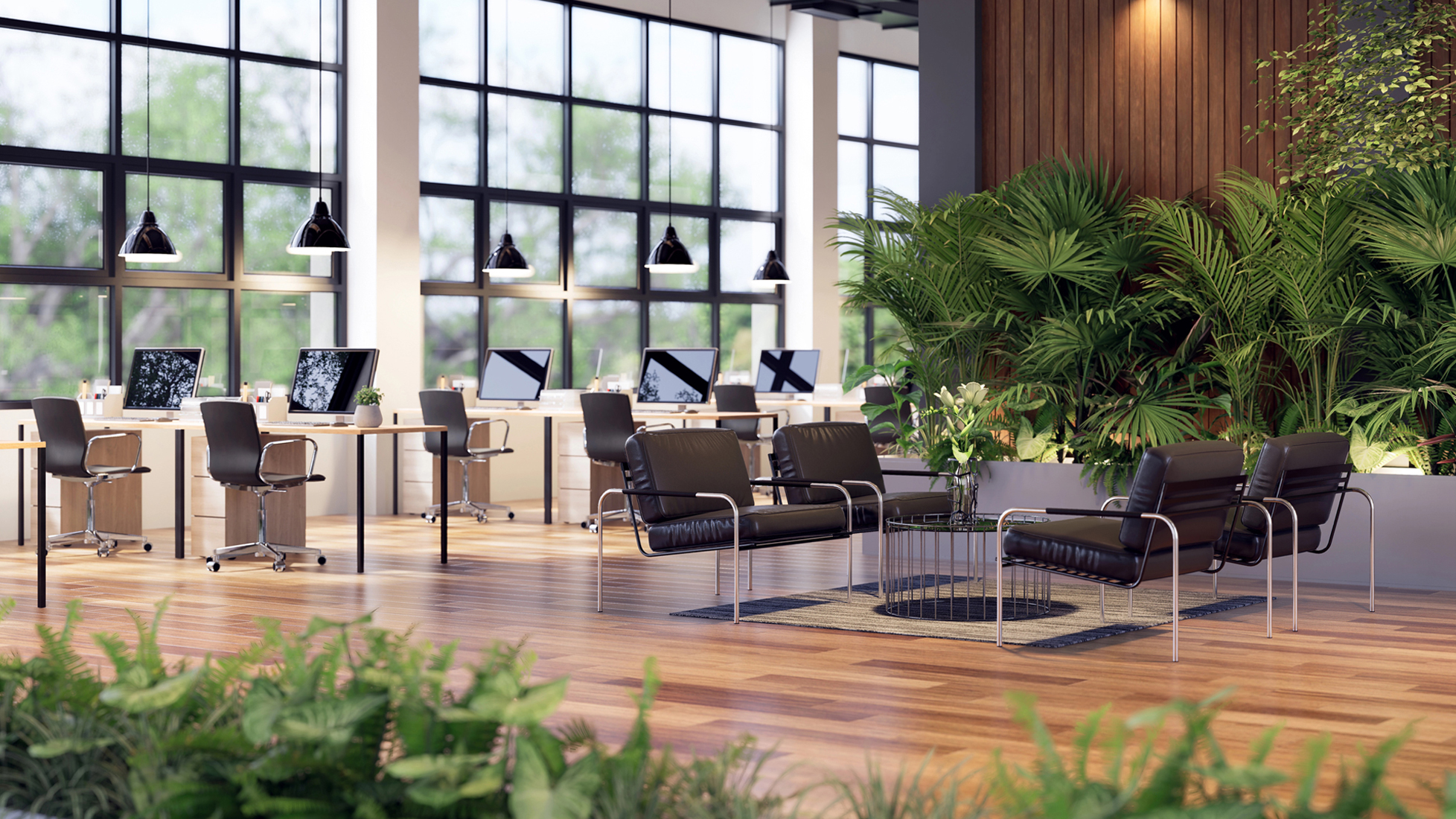


When you think of office space, you don’t automatically think of nature, or our love of nature and living things. In fact, if you were to ask anyone, what comes to mind when asked what they’d find in an office, most people would say computers, equipment, office furniture, desks, chairs, tables, and meeting spaces. It’s highly unlikely that they would list anything to do with nature. However, over time Kent and London office design and refurbishment has evolved as research has shown just how important nature is to human beings, especially in an indoor environment. This is known as biophilia. Consequently, the incorporation of natural elements into office design has started to become quite “natural”/the “norm”. The process of incorporating nature indoors is called biophilic design. So, what is biophilia and biophilic design?
What Is Biophilia?
The word “biophilia” was first introduced by the German American social psychologist, Erich Fromm in his book “The Heart of Man: Its Genius for Good and Evil” published in 1964. He described biophilia as “a psychological orientation of being attracted to all that is alive and vital” and a drive toward growth and self-preservation.
The term biophilia was later taken up by Dr. Edward O. Wilson an American biologist, ecologist, and entomologist who developed the field of sociobiology, in his book, “Biophilia” which he defined as “the urge to affiliate with other forms of life” and the “innate tendency [in human beings] to focus on life and lifelike processes”.
Others have described biophilia in similar ways:
- The ScienceDirect journal describes biophilia as “the innate tendency to focus on life and lifelike processes, reflecting the emotional affiliation of humans to other living organisms, which has evolved over millennia and is part of our genetic makeup” and
- Biophilic Innovations suggest it’s “a proposed human tendency to attend to, affiliate with, and feel drawn toward life and life-like processes.”
Dr. Wilson went onto develop the biophilia hypothesis which suggests that humans have a genetically based, inborn, instinctive, evolutionary tendency to seek connections with nature and other living organisms, derived from the fact that human survival depended on being able to read and work with nature over millions of years and as a consequence our brains closely link nature with our continued existence.
What Is Biophilic Design?
The majority of buildings have been made from man-made materials, which is the antithesis of being one with nature.
Stephen Kellert recognised that “the prevailing approach to design of the modern urban built environment has encouraged the massive transformation and degradation of natural systems and increasing human separation from the natural world. This design paradigm has resulted in unsustainable energy and resource consumption, major biodiversity loss, widespread chemical pollution and contamination, extensive atmospheric degradation and climate change, and human alienation from nature. This result is, however, not an inevitable by-product of modern urban life, but rather a fundamental design flaw” in his book “The Theory of Biophilic Design”.
Kellert went onto say “We designed ourselves into this predicament and theoretically can design ourselves out of it, but only by adopting a radically different paradigm for development of the modern built environment that seeks reconciliation if not harmonization with nature. This new design paradigm is called here “restorative environmental design,” an approach that aims at both a low-environmental-impact strategy that minimizes and mitigates adverse impacts on the natural environment, and a positive environmental impact or biophilic design approach that fosters beneficial contact between people and nature in modern buildings and landscapes.”
He later translated the theory of biophilia into an “architectural practice” defining biophilic design as “the deliberate application of humanity’s inherent affinity for nature in the design of built environments.” By connecting biology, environmental psychology, architecture, and building science Kellert went onto establish a structured, evidence-based framework that gave designers a way integrating nature into practical building design, enabling designers to create spaces that nurture the relationship between nature and the built environment.
To achieve this architectural practice Kellert developed two main dimensions and six core elements.
The two dimensions are:
- The organic or naturalistic dimension which relate to shapes and forms in the built environment which can be direct, indirect, or symbolic representations of nature and;
- The place-based or vernacular dimension which connect a building or landscape to the unique ecology and cultural history of the local area.
The two dimensions are expressed as six core elements which are also broken down into a number of attributes. These are:
- Environmental features to create a sense of connection with nature such as natural daylight, ventilation, colour, the use of natural materials, water, plants.
- Natural shapes and forms that imitate the organic forms of nature such as spirals, curves, domes, arches, shapes, and patterns found in nature, rather than the use of straight edges.
- Natural patterns and processes found in nature like dappled light, shifting shadows, and the aging “patina” of natural materials which connects our senses and perception of the passing of time.
- Light and space through the use of natural lighting to create dynamic forms, using reflective surfaces, varying the use of light depending on a space’s purpose, the interplay between light and shade and space can be used to balance spaciousness with constrained areas and provide a link between outdoor and indoor environments.
- Place based relationships to tie a meaning to a place and to create strong connection with places through “spirit of place” and historic, cultural features and the use of local materials.
- Evolved human-nature relationships focussed on how our relationship with nature has been shaped through our evolutionary psychological demands such as our need for a sense of safety and secure spaces as well as the desire for exploration and discovery and control over our environment.
Kellert’s architectural practice laid the foundation and encouraged many office designers to consider ways of introducing natural elements, when it comes to the design of the office.
Time Spent Indoors and Lost Working Days
According to Opinium, and other sources we spend 90% of our time indoors. We also spend around 30% of waking hours at work.
An estimated 148.8m working days were lost in the UK in 2025 to sickness and illness which equates to on average, 4.4 days lost per worker. The main reasons given for work place absences were 30.4% minor illness, 15.6% other conditions, 14.6% musculoskeletal problems including back pain, neck, and upper limb problems and 8.9% mental health conditions including stress, depression, anxiety, and serious mental health problems.
The UK government’s “Keep Britain Working: Final report” which was updated on 31 March 2026 says “the state faces an unsustainable cost from economic inactivity due to ill-health of £212 billion per year, equivalent to 7% of GDP or nearly 70% of the income tax we pay, through lost output, increased welfare payments and additional burdens on the NHS.”
The Royal Society for Public Health (RSPH) states that the cost to the UK economy of 148m lost work days is £141bn. Based on these numbers the RSPH, like many others, is calling for healthy workplaces that support good physical and mental health at work.
How Can Biophilia Help?
Given the amount of time we spend indoors, and at work, our indoor environments can have a major impact on our health and wellbeing, immunity, attention, creativity, and productivity. Through science and surveys, we know that human beings are “hard-wired” to need, feel and perform better when we are in settings that are “closer to nature.” The pull that we feel towards nature can be somewhat alleviated by bringing the outside inside and creating a connection between nature and the workplace. This has been shown in numerous studies and research papers, some of which are outlined below.
Physical Health
Physical health can be positively impacted by biophilia in the office. Scientific research demonstrates that engaging with nature or incorporating natural elements into the built environment provides measurable physical health benefits, including reduced blood pressure, lower stress hormone levels, and improved immune function.
PubMed’s “Can Even a Small Amount of Greenery Be Helpful in Reducing Stress? A Systematic Review” looked at studies in eight different countries which assessed how stress reduction interventions impacted blood pressure and the State Trait Anxiety Inventory (STAI) and found that even very small-scale greening, including indoor green walls and potted plants, were an effective help for stress relief.
The BBC found that just 20 minutes of nature can boost your health. They explain that when you’re in the presence of nature you unconsciously relax as your “autonomic nervous system – a network of nerves controlling unconscious processes – responds instantly.” This is backed up by a study which shows that just three, ten minutes or more periods spent in any space that incorporates nature can produce a drop in cortisol levels which is one of the physiological biomarkers of stress.
Mental Health
As well as physical health, mental health can also be positively affected by being in the presence of nature. Given that “Mental health problems cost UK economy at least £118 billion a year – new research” biophilic design may provide at least part of the answer to tackling mental health issues in the workplace.
According to a PubMed neuropsychological study which looked at whether applying biophilic spatial design in hospital spaces could help the mental health of nurses working in high-stress environments. The study used a control room with plain white walls and a biophilic space where the walls were entirely covered with vegetation. They found that even 10-minute durations of exposure to the biophilic space “significantly reduced oxyhemoglobin (oxy-Hb) concentrations in the DLPFC, reflecting relief from cognitive–emotional overload and enhanced neural stabilization.” The paper goes onto say that the study demonstrates that even brief exposure to an indoor biophilic environment can produce neuropsychologically restorative effects.
Interestingly a Proceedings of the National Academy of Sciences (PNAS) research article found that a nationwide study of around 900,000 people showed that children who grew up in areas where there were low levels of green space had up to 55% higher risk of developing a psychiatric disorder independent from effects of other known risk factors. The article states that “There is increasing evidence that the level of exposure to natural environments impacts mental health.”
Immunity
Biophilic design elements can promote physiological relaxation, which triggers immune-boosting responses through stress reduction, decreased neuroinflammation and increased Natural Killer Cell (NKC) production.
In a systematic review of Health effects of plants, light, and natural elements of biophilic interventions in confined settings it was found that “greenery in confined settings improves mood, and accelerates recovery, consistent with Stress Reduction Theory (SRT) and Attention Restoration Theory (ART).” The review goes onto say that the presence of living plant systems reduces stress, enhances mood, and fosters a sense of connectedness to nature in contexts where natural stimuli are otherwise absent.
In a pilot study which used a 32-channel quantitative electroencephalograph (qEEG) to study relative changes in neuroinflammatory markers when participants were exposed to 2D digital images of buildings that showed varying degrees of biophilic design they found that exposure to buildings with higher degrees of biophilia may result in decreased neuroinflammatory activity.
Indoor living plants that produce the right airborne compounds, phytoncides, which are natural, airborne antimicrobial essential oils that plants and trees release to protect themselves from insects, fungi, and disease can help boost your Natural Killer (NK) Cells which are the specialised white blood cells that act as a front-line defence in your immune system.
Better Concentration/Reduced Attention Fatigue
Exposure to nature can significantly boost concentration and cognitive function by overcoming attention fatigue.
According to the journal Frontiers in Psychology there is increasing evidence that shows that exposure to natural elements such as plants and natural light can play an important role in “attentional restoration, emotional modulation, and fatigue intervention” as these natural elements can overcome the brain’s mechanism which works to suppress distractions and maintain focus. The brain’s need to maintain focus can lead to “directed attention fatigue” as it can become overworked, which in turn can lead to fatigue, irritability, and poor decision-making. Known as the Attention Restoration Theory, it’s believed that natural elements allow the brain’s “cognitive resources to replenish.”
Oasis agrees. In their article “The Power of Green: Biophilic Spaces for Neurodivergent Well-being” they say that when we are in the presence of nature the attention we use for focussed tasks can rest and recover. Nature provides a gentle stimuli that’s not demanding, unlike other stimuli, and which can reduce mental fatigue and improve concentration. They onto say that “a more natural environment can support better focus and cognitive performance.”
Creativity
Natural elements allow the brain to reset and restore cognitive functions, freeing up mental resources for complex, focused, out-of-the-box and more creative thinking.
Researchers looked at whether “Natural elements in the designer’s work environment influence the creativity of their results” and found that environments that include elements of nature, whether real or artificial, appear to increase creativity to a greater extent when compared to environments without any natural elements.
In another study which investigated the effects of different natural environments on attention restoration and creativity, it was found that environments “of high- and medium-naturalness” improve creativity. The paper states that “Our study indicates that viewing natural environments stimulates curiosity and fosters flexibility and imagination, highly natural environments distract our minds from work, and the benefits of attention restoration can improve the uniqueness and diversity of creative ideas.”
In a study looking at “Improving Creative Reasoning through Immersion in Natural Settings” there is a cognitive advantage in spending time immersed in a natural setting which lead to increases in performance on a creativity, problem-solving task by a full 50%.
A Human Spaces new research report “The Global Impact of Biophilic Design in the Workplace” says that in businesses where there is the presence of natural elements in the workspace they see a jump in performance and creativity. In the report’s key messages, it states “Those who work in environments with natural elements, such as greenery and sunlight, report a 15% higher level of creativity than those with no connection to natural elements in the workplace”.
A ProQuest paper “Bringing Nature Indoors with Virtual Reality: Human Responses to Biophilic Design in Buildings” highlights research which was conducted using a tool which combined virtual reality (VR), eye-tracking and wearable biomonitoring sensors. The researchers conducted multiple experiments with different study design to measure physiological and cognitive responses to different biophilic indoor environments and found significant physiological and cognitive benefits including reduced blood pressure and skin conductance, improved short-term memory, lower level of physiological stress indicators and higher creativity scores in indoor environments with diverse biophilic design features.
Productivity
Productivity can also benefit from biophilic design.
Research published in ScienceDirect found that when thirty-seven participants, in three cohorts, were exposed to three biophilic design interventions (visual, auditory, and multisensory) such as “visual projections of greenery with canopy-type structures, water features, and artwork that was congruent with the sounds being introduced to the space”, results demonstrated that immersive biophilic environments can improve occupants’ satisfaction and cognitive performance, while reducing stress.
The same Human Spaces research report previously mentioned, details an online study of 7600 office workers from 16 countries across the world and found that “those who work in environments with natural elements, such as greenery and sunlight, report a 15% higher level of well-being than those who work in environments devoid of nature. Those who work in environments with natural elements, such as greenery and sunlight, report a 6% higher level of productivity than those who do not have the same connection to nature within their workspace.
Attract and Retain Staff
It’s clear that biophilia plays a role in staff health and wellbeing in the workspace. Designing an office space with natural elements is seen as a positive when it comes to retaining and attracting staff.
In today’s competitive job market, a workspace that’s well designed and incorporates natural elements making employee health and wellbeing a priority and creating a people first culture which directly addresses the modern demands for a healthier work environment can be a very attractive prospective for new staff and signals to current staff that their company cares about them. Staff who feel valued are more likely to stay with their company for the longer term.
Bringing The Outside, Inside Through Biophilic Office Design
Biophilic office design involves designing your office space so that your staff can connect with nature, by bringing the outside, inside. There are many natural elements that can be incorporated into the office to provide a space that not only encourages productivity and creativity and boosts cognitive function but also provides an environment tailored towards staff health and wellbeing. A few of the many elements that a biophilic office design should look to incorporate are outlined below.
Natural light should be used wherever possible and where partitioning is required use glass partitions to allow natural light to flow through an office space.
Introducing plants into an office design is vital in biophilic design as they naturally purify the air, reduce stress, function as a noise barrier, and improve overall employee wellbeing. There are a multitude of creative planting arrangements that can be used in any office space including plant and moss walls, living pictures and plant walls, plant racks, shelves and dividers, cabinet and container planting and hanging plants.
Natural materials should be used wherever possible in furniture and flooring such as wood, cork, stone, and bamboo. Choose seating and other décor that has curved organic shapes rather than harsh, straight lines. Use the colours of nature in colour schemes and find artwork that features landscapes, wildlife, or fractal, flowing patterns.
It’s also important to control the fundamentals such as layout, temperature, ventilation, and noise alongside the elements above to ensure an office space translates into a welcoming, productive environment that embraces nature.
JBH Refurbishments, Experts In Office Design and Refurbishment
JBH Refurbishments are a cat a and cat b fit out contractor and have over 30+ years experience in Kent and London inclusive office design, office refurbishments and fit outs. We understand what’s required to carry out a biophilic office design and refurbishment and can provide the right expertise for your Kent or London office refurbishment. You can contact us on 0333 207 0339 or via our contact page for a free on-site consultation.