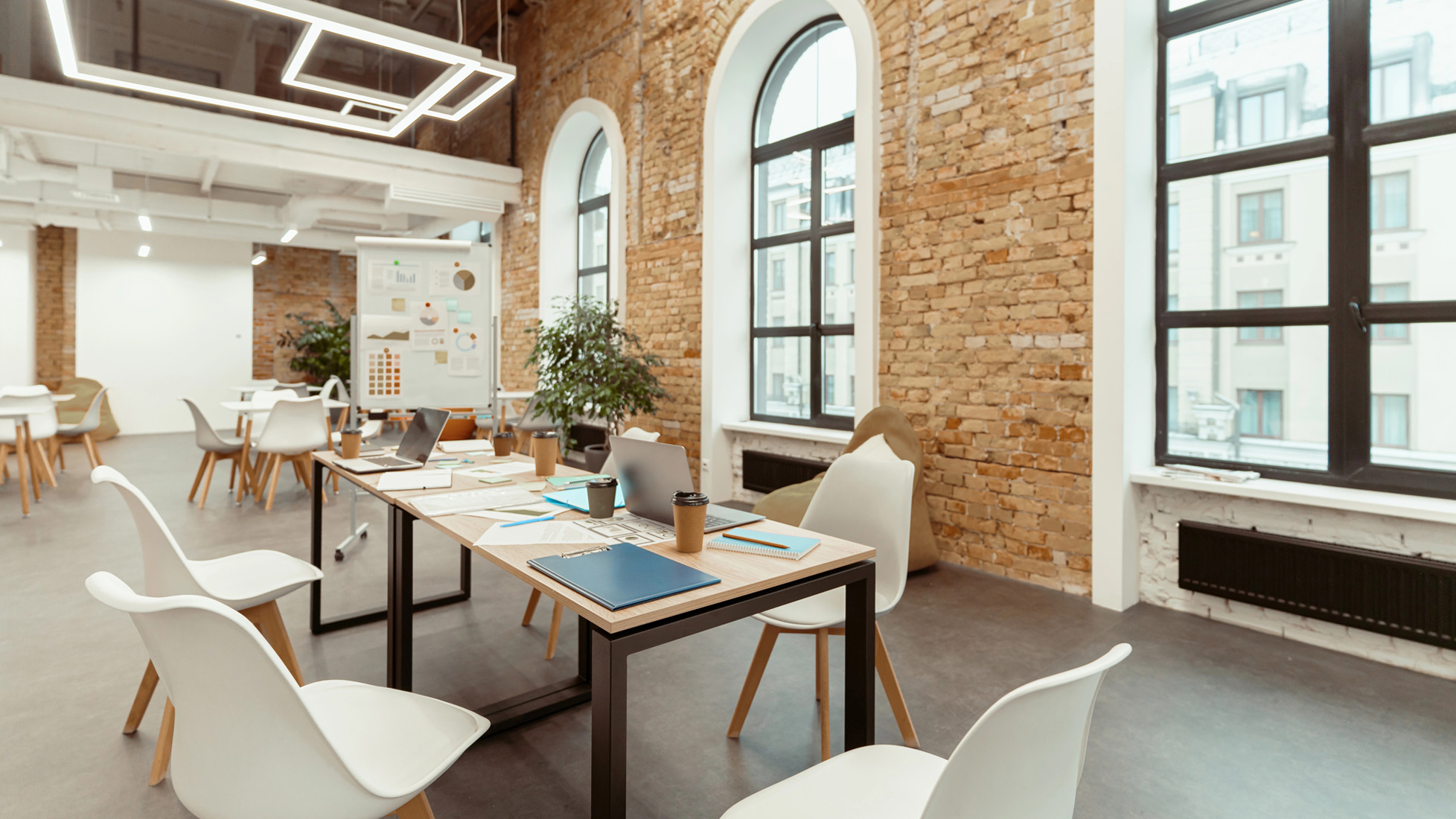
Office design has changed over the years and will continue to evolve into the future. With another year coming to an end, it’s a good time to look ahead at why office design changes and to outline some of our office design predictions for 2026.
Key Reasons For Changing Your Office Design
There are a number of key reasons why office design changes are required. This can be in direct response to downsizing or upscaling, the need for better space utilisation, changing work processes, cultural shifts, and technological advancements.
Downsizing or Upscaling
Businesses may find that they need to downscale due to changes in priorities or direction, or to reduce inefficient work practices. or upscale to meet a growing demand or take on new projects or staff. When a business needs to downscale or upscale it can impact the office design as the current office layout and space usage needs to be re-evaluated to ensure it’s being utilised efficiently and effectively and still meets the needs of the business, current staff and any new staff.
When a business downscales, it provides an opportunity to look at redesigning the current office space to be more efficient and realigned towards current business needs or it may mean moving to a smaller office space where the new office is designed to align with the company’s need for a smaller footprint.
On upscaling a business may need to move to new premises or redesign their office space to accommodate an increase in size, taking on more staff and ensuring there is sufficient space including additional workstations, meeting rooms and breakout areas and infrastructure such as heating, ventilation, air conditioning, lighting and power sources to accommodate an increased headcount. It’s important that the office isn’t overcrowded and that all staff have an adequate amount of space to be able to work effectively.
In both cases it’s important to look at the office design to maximise the way space is utilised, to ensure the space allows effective workflow and collaboration and to build in flexibility to cater to future changes.
Improving Space Utilisation
Given the cost of office space, especially in London, it’s vital to ensure that office space is being used efficiently to meet business and staff needs. Wasted space is wasted money and could potentially be holding your business back.
Advanced Workplace Associates (AWA) a global workplace consultancy produced a report on The Utilisation of the Office looked at how UK office space was used over a two week period, with four observations per day in 75 buildings, 36100 desks, 542 hot desks, 728 meeting rooms (ranging in size 4, 6, 8 and 10 people) and in buildings with populations ranging from 20 to 3284 workplaces, over a period of five years. They found that the average utilisation of occupied desks was 48% (with a minimum of 27% and a maximum of 74%). Throughout the week daily occupancy was similar except on Fridays when occupancy drops, believed to be a day that staff prefer to take time off or work from home. Space utilisation is higher in London, most likely due to “the pressure in London to increase utilisation because of the higher level of rent.”
AWA also report that where hot desks are in use their utilisation is on average only 16%. Meeting room utilisation is also poor with on average only 39% of meeting rooms being used. This percentage drops to 19% when a meeting rooms total capacity is considered. Meeting spaces located in open plan areas are only utilised 9% of the time making these spaces the worst used office spaces. AWA go onto say that the implementation of Agile/Advanced working practices in the office leads to an improvement in utilisation of on average “7% based on a 12% reduction in workplaces.”
Where office space is suspected to be underutilised office design can help to address the issue.
Changing Work Processes
New projects which result in changing work processes can require a change to a business’s office design. When projects, processes or objectives change it makes sense to review how an office space is being used and make changes to ensure that the space is employed efficiently, staff can work effectively and work processes flow naturally.
There are a number of different working styles that require layout changes.
Activity Based Working (ABW) bases its office design on office space which supports the task, providing different settings for different tasks including standard meeting rooms, quiet rooms, break out areas or collaboration areas. Instead of staff having a fixed workstation they are free to move to different parts of the office. By staying mobile staff can be flexible in where they work allowing them to move to the best space or setup for a specific task.
A business may want to implement an Agile Working (AW) office design if the nature of their business requires staff to work from multiple locations, in the office, from another office, from home or on the move. An agile, flexible office design facilitates and enables staff to choose when and where they want to work in the office. It’s designed for maximum flexibility. It can be changed on demand and can easily and simply adapt to any given circumstance so it can cater to current and future business needs.
Hybrid based working which became prevalent during the pandemic has similar office design requirements to an agile office in that it requires the office to adapt to changing circumstances as easily as possible.
Cultural Shifts
There have been a number of cultural shifts triggered by research, technological advances and attitudes which have impacted office design including a realisation that staff health and wellbeing is vital to a business’s productivity and success; and the need to minimise the impact on the environment.
Health and Wellbeing
Staff health and wellbeing has been a major driver in changing office design. In the past office design trended towards efficiency and productivity, unfortunately at the expense of health and wellbeing. As research began to show that regimented, packed office spaces could impact health, office design started to evolve to support health and wellbeing bringing with it a host of benefits.
Today’s modern contemporary office design is focussed on providing staff with flexibility, control, a balance of private vs collaborative work spaces and breakout areas with the overall aim of promoting health and wellbeing and productivity.
Drive To Net Zero
Sustainable office design has become more prevalent with the UK government’s drive to net zero and the findings of the UK Green Building Council (UKGBC).
A report by the UKGBC found that “Commercial offices in the UK account for circa 11% of energy consumption from non-domestic buildings… offices are currently the largest single consumers of electricity, at 15.5% of all non-domestic buildings. Similarly, while only 7% of non-domestic buildings are over 1000 sqm in size, these large buildings account for over half of all total energy consumption. Decarbonising large buildings will, therefore, have a more significant impact on total energy consumption per building retrofitted.”
The UKGBC report is backed up by UK Government findings in “The Non-Domestic Private Rented Sector Minimum Energy Efficiency Standards (MEES) Implementation of the Energy Performance Certificate (EPC) B Future Target” which states that “The Government recognises that improving the operational performance of non-domestic buildings is absolutely vital. Commercial and industrial buildings above 1,000m² account for only 7% of all non-domestic buildings, but use over half of the total energy used, and carbon emitted, by all non-domestic buildings.”
Technological Advancements
Changes and advancements in technology have allowed office design to adapt and change to meet new needs.
Technology has played a vital role in the support of changing work styles such as agile, hybrid and remote working by providing the tools to allow communication and collaboration. Reliable internet and appropriate video conferencing technology allowed staff to work and connect no matter whether they are in the office, away on business or at home maintaining good communication and collaboration with staff inside and outside the office. Booking systems for workspace, meeting room and collaboration areas will continue to play an important role in ensuring office space is never overbooked, providing reliability and security so that staff know there will always be space for them when they choose to work from the office.
Technology has also been used to make the workspace more inclusive. Incorporating assistive technologies provides staff with the tools they need to do their work.
With the push towards net zero, technology is being employed to help reduce energy consumption through the monitoring and control of lights through motion and light sensors to automate turning lights on or off based on occupancy or ambient light levels; and the control of temperature through heating, ventilation and air conditioning which can adjust office temperatures to cooling or heating as required or send an alert if temperatures approach freezing, helping you prevent burst pipes. Water usage can also be monitored using sensors and smart meters to provide real-time data and detect leaks.
Smart technology can deliver full security solutions including access control replacing traditional keys with key fobs, key cards, fingerprint or facial recognition; visitor management including guest registration and badge printing; video surveillance to identify people or vehicles; smart sensors or alarms to detect motion, open windows or doors and environmental changes.
Predictions
There are many reasons why businesses look to change or update their office design, some outlined above. Many are driven by necessity, some by cultural changes and others because a change will move a business forward. Below we outline some office design predictions for the coming year. Office workspaces will need to be able to adapt to changing needs, be inclusive, sustainable, smart, and comfortable with a focus on health and wellbeing.
Flexibility and Adaptability
Building in flexibility and adaptability in office design allows businesses to adapt as circumstances change. Having a flexible office environment allows for a variety of work practices including agile and hybrid working. It’s also the cornerstone of inclusivity. Todays and tomorrow’s contemporary office design must be focussed on finding a balance of work spaces to allow for different work styles and supportive spaces designed to allow for privacy and teamwork, quiet and collaboration with the overall aim of promoting productivity and health and wellbeing.
In order to make rapid changes office furniture should be modular, adaptable, multifunctional, and movable and easy to take down and move around as required. Multipurpose screen dividers e.g. living walls and plant wall dividers, storage walls, flexible partitioning and “write on” walls that can be easily moved as required can also provide adaptability.
It’s important that staff can control their environment by giving them the ability to make choices such as being able to adjust the office temperature and choose from different lighting levels. Having ergonomic desks and chairs that can be adjusted to individual staff needs is also important.
Inclusivity
Recognising and including diverse employee physical, cognitive and sensory requirements and needs to ensure inclusivity will continue to be essential.
Designing for accessibility is important and should be carefully considered as part of the early design phase. Layouts should be intuitive to allow staff to find their way around an office space. Clear signage in all areas along with large print, screen magnifiers, digital navigation aids, audio descriptions, high contrast visuals, braille displays, voice activated, recognition systems and hearing assistive technology will help staff with hearing and visual disabilities find their way around an office more easily.
Making routes accessible by designing automatic doors, access ramps and railings or lifts, wheelchair-accessible layouts and wider doorways, corridors, and spaces between desks can also improve accessibility. Modular workstations that can be adjusted to individual needs and ergonomic chairs, standing, height adjustable desks, desk mounted sockets, adjustable monitor arms, cable management racks, accessible storage, height adjustable kitchen sink units and work tops, grab rails in washrooms, lower washroom basins and accessible parking bays close to the building entrance should also be considered.
Accommodations for sensory, cognitive, and neurodiverse requirements as well as physical disabilities also need to be taken into account including appropriate lighting, installing noise reduction measures such as acoustic ceilings, acoustic pods, carpets to deaden footfall noise and quiet zones. Offering flexible and varied workspaces including private areas, collaborative spaces and quiet zones will help to support different tasks, workstyles, and requirements in terms of neurodivergent needs.
Better Health and Wellbeing Outcomes
Health and wellbeing will continue to be an important office design factor into the future. There are numerous office design factors that can positively impact wellbeing.
Using natural materials such as wood, stone and fabrics like cotton in the flooring, doors, counter tops and office furniture; using natural light wherever possible and the use of plants, plant or moss walls, cabinet planting and hanging plants is a good way of bringing the outside inside which research shows helps reduce stress and anxiety, boosts mood and happiness and enhances focus.
Offering a variety of workspaces, quiet areas, and breakout spaces allows staff to choose where they work depending on their needs. Whether it be an open office space, a private office or a meeting area, having the choice of where to work gives staff control over their work environment. Breakout spaces are also a vital part of the mix as they allow staff to “break” from work, refresh their minds, prevent decision fatigue, and reduce stress. They are also a great way to encourage socialisation.
Designing for inclusivity brings with it better health and wellbeing outcomes. With inclusion comes a sense of belonging and value resulting in a healthier workplace environment. Naomi Humber, Head of Mental Wellbeing at Bupa Health Clinics says “An employee who feels psychologically safe, supported and valued as an individual will be able to perform at their best and thrive in their working environment. They are likely to be more engaged with their role and employer’s purpose. This can lead to greater productivity. Those who do not feel that they belong, or are unsupported within the workplace, are at increased risk of developing issues with their health and wellbeing. This in turn can adversely impact themselves and their company.”
Workplace furniture is often overlooked or an afterthought but can have a major impact on health if not carefully considered. Providing comfortable, ergonomic, adjustable furniture should form part of an office design.
Evolving Technology
In the past technology made agile and hybrid working practices possible through infrastructure and tools. It’s allowed for the monitoring and control of energy consumption. It’s helped deliver solutions to make the workplace more inclusive and it’s provided enhanced security for buildings.
In the future, as technology advances it will continue to shape office design by helping to create smarter, more flexible, more inclusive, human-centric office spaces that bring together the physical and digital world through data driven advancements.
Sustainability
Sustainability is here to stay. All future office design will need to carefully consider sustainability through the reuse, recycling and repair of office building materials such as glass partitions, fire doors, office kitchen units and reception desks which can all be reused; wooden reception desks, panelling and shelving which can be given a new lease of life. Upholstered furniture could also be reused by reupholstering. Carpet tiles that no longer work with the new office look could be recycled through the original manufacturer.
As part of the office design process any new products that are to be used should have good sustainability credentials such as wood products which should have the Forest Stewardship Council (FSC) credential, or the Programme for the Endorsement of Forest Certification (PEFC) which demonstrate how they have been sustainably sourced and maintained. Any old office materials which are being removed from your building space should be “sustainably” disposed of. An example of good practice would be to send any wooden flooring that’s removed to a reclamation yard to be reused rather than send it to landfill.
Natural light should be used wherever possible which will help to reduce the amount of artificial light that’s then required throughout your office space. Wherever artificial light is required low energy LED lighting systems should be used as they are more energy efficient.
Where possible plants should be included in the office through living walls (or green walls), floor standing plants, and wall partitions. Dual flush toilets or low-flow toilets which use less water, and low flow or sensor taps or aerators which create a mist/spray which use less water for washing should be considered.
Incorporating smart technology into an office design can help to monitor and collect data about where energy, water, and consumables are being used within your office space to help you to reduce waste and making energy savings.
Office design will never stand still. It must change to meet a business’s needs and take into account specific requirements and utilise new solutions in order to be able to best meet those needs. At JBH Refurbishments we know one size doesn’t fit all.
JBH Refurbishments, Experts In Office Design and Refurbishment
JBH Refurbishments are a cat a and cat b fit out contractor and have over 30+ years experience in Kent and London office design, office refurbishments and fit outs. We can provide the right expertise for your Kent or London office refurbishment. We understand what’s required to carry out an office design and refurbishment to meet your business and staff needs.
From your brief, to putting together a project plan, to developing your office design and layout to delivering your office fit out JBH Refurbishments will provide the right expertise for your project providing peace of mind. You can contact us on 0333 207 0339 or via our contact page for a free on-site consultation.